
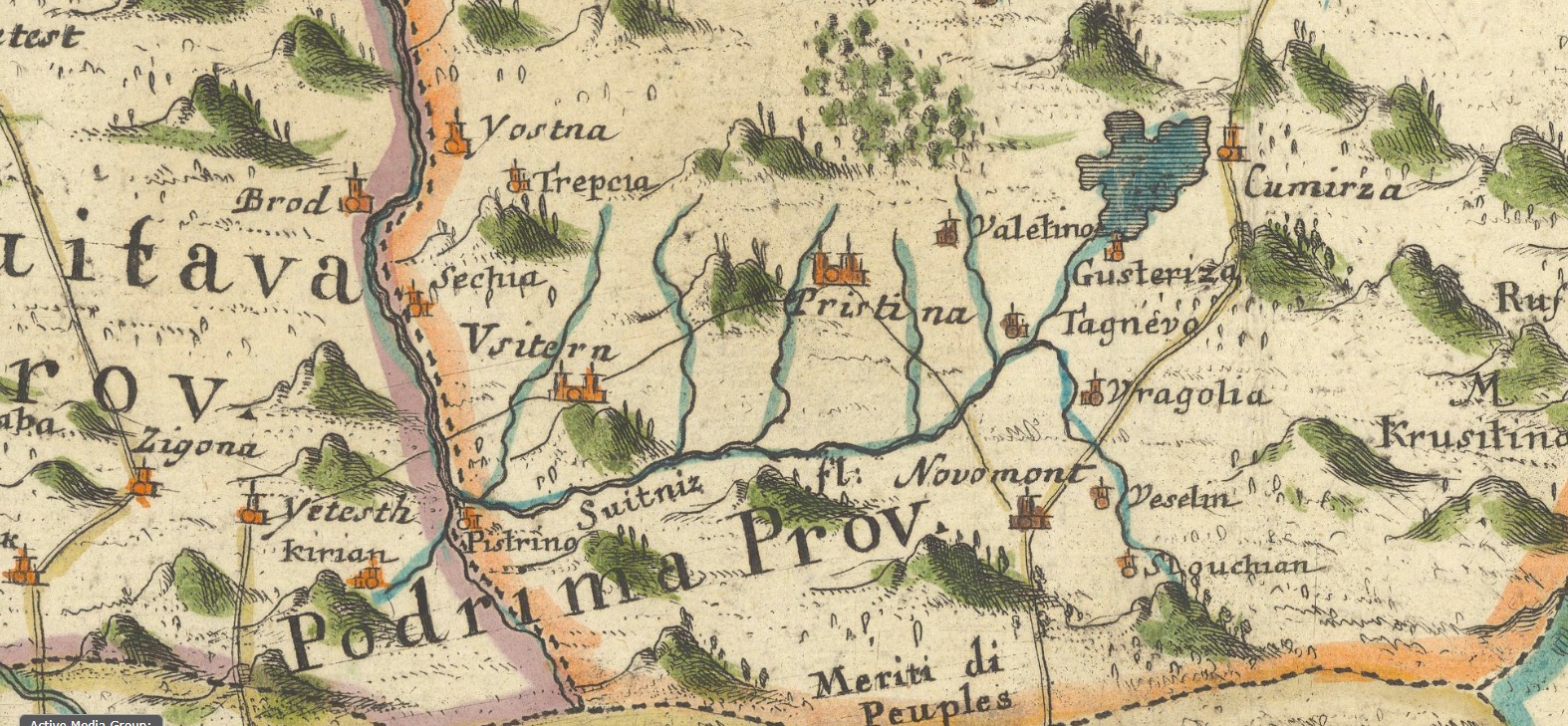
*This is an updated version of an older article: Gjinolli family and the Pashallek of Prishtina.
The Gjinolli family had a great reputation in Kosovo as one of the most important ruling families, known for their leading role in Prishtina and the surrounding region. Despite their historical and political influence during the Ottoman period and later, structured efforts to analyze and document their legacy have been rare until today. The purpose of this article is to contribute to this direction. Drawing from available archival data, primarily from Ottoman sources newly deposited in the Archives of Prishtina, this paper attempts to provide a more complete picture of the developments that influenced the Gjinolli family's position in the region. The documentation allows us to reconstruct the family's historical trajectory, shedding light on their glorious periods as well as the challenges they faced. In addition to Ottoman archival sources, the study relies on and examines the findings of scholars who have addressed these issues, thus offering a layered perspective on the activities of the Gjinollis across different generations.1
Origin and Rise
According to the family's own descriptions, the Gjinollis originate from the Kukës district and belong to the Krasniqi tribe.2 As we will see below, this narrative is also supported by at least one archival document. However, not all scholars easily agree that this is the whole truth. The hypotheses regarding the family's origin vary; some even date back to much earlier times—the 15th century—although archival documents do not allow for a continuous reconstruction of the chronological trajectory.3 One such claim assumes the family originated from Novo Brdo, while another suggests Herzegovina. Since the proposed hypotheses are still in search of documentary evidence, we will not delve too deeply into this matter.4 This is particularly because a cluster of Ottoman documents among those at our disposal, as mentioned, clearly point to an origin "from Gora." Meanwhile, regarding the other two hypotheses, despite all our efforts, we have found nothing new to add beyond what has already been stated by the respective authors.
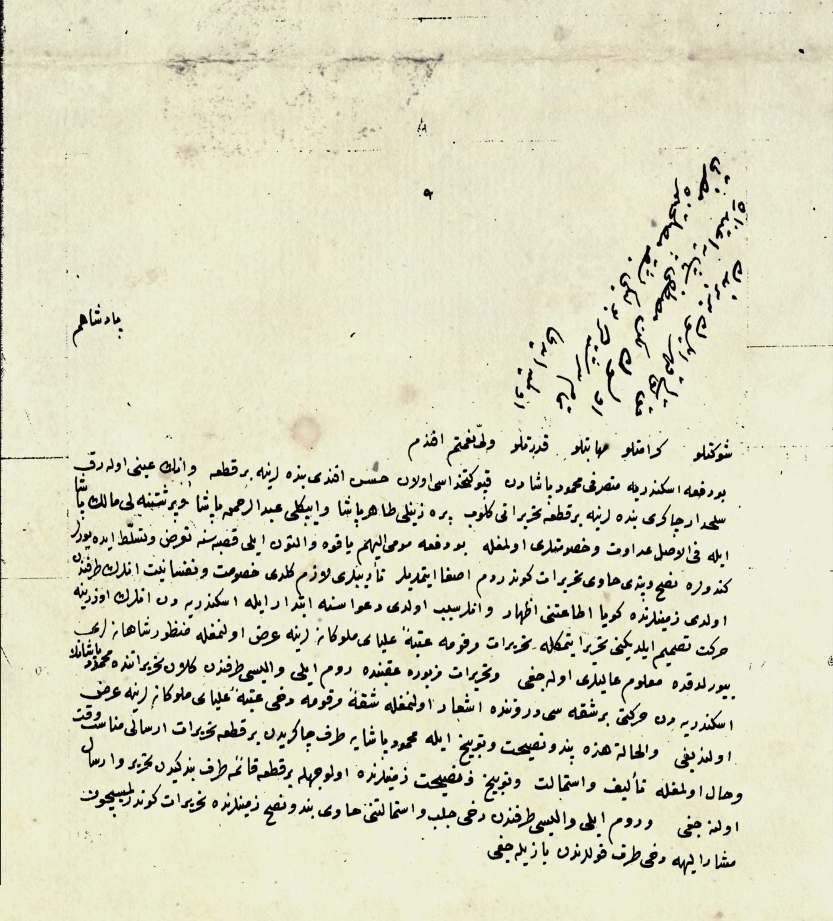 Letter of Maliq Pashë Gjinolli from 1795.
The oldest member of the family recognized in Ottoman archival documents is Hysrev, the son of Gjin, or Cinoğlu in Ottoman and Turkish, who in some cases also appears as the son of Gjin Aliu or Ali Gjinzades.5 Who Gjin, the family's ancestor, might be is difficult to say with the data currently available to us.6 The Turkish encyclopedist M. Süreyya mentions an Albanian bey named Gjin Aliu at the turn of the 17th century, who made a name for himself serving as the mutasarrif of Herzegovina.7 Based on this encyclopedic entry, the Serbian historian Šešum, having tracked down this character, provided further details about his life. This scholar posits him precisely as the founder of the Gjinolli dynasty.8 However, Šešum's hypothesis regarding the origin of the Gjinollis, as precise as this scholar is in his other investigations, leaves two main problems unresolved.
First, the connection between Gjin Alia of Herzegovina and the Gjin Alia who appears in Prishtina at the beginning of the 18th century. The latter, between 1701 and 1702, and then again from 1709 to 1714, was the holder of mines in the Prishtina and Vushtrri region.9 The links between this mine owner and Gjin Aliu of Herzegovina are not proven; they are merely assumed by Šešum. These connections become particularly problematic due to the fact that the Herzegovinian was imprisoned in Verona on June 24, 1690, and nothing more is known of his fate since then.10 Meanwhile, Gjin Aliu of Prishtina is not known before 1702. On the other hand, through the Ottoman documents brought to Prishtina, we do not have any more detailed data on Gjin Aliu. The latter, as stated, is mentioned only as a surname for Ibrahim Pashë Gjinolli.
A second problem in Šešum's hypothesis appears in the even more problematic direct connection between Gjin Alia of Prishtina and the well-known Maliq Pasha.11 He does not mention the intermediate pashas at all, who, if for nothing else, should be sought out for chronological reasons. As part of this issue, Šešum is entirely unaware of Hysrev Pasha, who appears in the documents of later descendants as a founder of the dynasty. His study, however important and valuable, is accompanied by oversights such as *"Maliq Pasha is the son of Ibrahim Pashë Gjinolli,"12 when in fact Ottoman archival data, as we will see, clearly explain that Ibrahim Pasha was actually Maliq's (elder) brother.13
Ottoman archival data regarding this dynasty, at least those we have been able to examine so far, do not show any traces before the mid-18th century. The oldest evidence comes from a document dated 1763, which states that Mustafa, the son of Hysrev Bey Gjinolli, was selected among the nobles (ayans) of the city.14 In the same appointment letter, a Sejdi Sabedini and an Ibrahim Pasha are also mentioned; these may actually be Mustafa's two brothers, and other sons of Hysrev, who, as we will see, frequently appear in documents. A decade later, in 1774, they are mentioned again in the form of 'Hysrevbeyzade Mustafë Beu, Said Babedin Efendiu, and Ibrahim Pasha'.15 That they are brothers is better explained in a document from 1785, which states more explicitly that Prishtina was ruled by "Ibrahim Pasha, son of Hysrev, with his brothers Mustafa and Yahya, and with the high official Said." One of the letters states that their father, Hysrev, had been the commander of Gora, *"the place where the family also came from."16 Jashar Pashë Gjinolli, Maliq’s nephew, states in his vakfiyya (endowment deed) written in 1836 that his grandfather was named Hysrev Gjinolli, which further confirms the notes of the aforementioned document.17 According to archival records, Ibrahim seems to have been the leader of the family with the title of pasha since at least 1774.18 Meanwhile, Said (elsewhere Ahmet Said) must be Ahmet Bahtijari himself, the father of Jashar Pasha, who held a high state post. It is possible that this refers to a figure who appears on two occasions as a sort of director of the postal organization in Prishtina, in 1770 and 1782.19
Ibrahim Pashë Gjinolli quickly encountered the limits of his power against the Sublime Porte, as his exile to Gora was discussed as early as 1775, although such a decision was never applied.20 In February 1784, he also appears as a defender of the fortress of Niš,21 which indicates a consolidated power. However, in September of the same year, he was accused of attacking and looting many enterprises in Prishtina, Vushtrri, and Dukagjin as the leader of the *"Albanian rebels of Llap and Gollak."22 The same accusations continue until July of the following year, 1785.23 In July 1792, his death was announced.24 Meanwhile, from tombstones in Gjilan, we learn that his brother Ahmet (Said) Bahtijari died in Gjilan in 1800, and his other brother Mustafa in 1811.25 Rashit Gjinolli died in 1796, along with his nephew Sylejman.26 Maliq is the only brother who lived into the following century.
Maliq Pashë Gjinolli (c. 1760–1824)
The most famous figure of the Gjinolli family is undoubtedly the youngest brother, Maliq. He must have been born in Prishtina around 1760, although exact records of his birth have not yet been found.27 In archival records, he first appears in 1785, alongside his brother Ibrahim and his other brothers Mustafa, Rashid, and Yahya.28 In a chain of letters in the summer of that year (June–July), Maliq and his brothers are accused of looting and persecution in the areas of Gora, Dukagjin, Vushtrri, and Prishtina. As mentioned previously, the brothers, under the leadership of the eldest brother Ibrahim, were at the head of a larger band of rebels from Llap and Gollak.29 Attacks by Albanian kachaks and bandits in the Prishtina district are also mentioned in 1788 and 1789, but these letters do not mention names. More or less around this time, in 1789, we encounter him for the first time with the title of pasha, at a time when his brother Ibrahim was still the main leader of the family.30
Holding this imperial rank, from 1792 onward, after his brother's death, he de facto ruled the Sanjak of Prishtina, which also had Artana (Novo Brdo) and Vushtrri under its administration. From time to time, he was also the leader of the Sanjak of Skopje, but always maintained his seat in the city of Prishtina.31 As the youngest brother, the reasons why Maliq took over the leadership of the family after Ibrahim's death are not completely known, but it seems that at this time his brothers Mustafa and Ahmet Bahtijari were living in Gjilan, the other important center in the possessions of this family.32 From this time on, he also began to be known as the Pasha of Prishtina.33
At the beginning of his leadership under this title, he faced the force of Mahmud Pashë Bushatlliu, who for a time during this period (1792) also captured Prishtina. However, Maliq quickly managed to restore his administration. In 1800, he was also appointed mir-i miran of Skopje, an important position that brought him power over almost the entire territory of present-day Kosovo. This is probably the period when the Pashalik of Prishtina reached the peak of its geographical expansion. According to Antoine Vassy, the French vice-consul in Prishtina, the city had influence over the entire surrounding region, but even he did not understand what the official boundary of the Pasha's power was. According to him, in some cases even Peja, Prizren, and Skopje were mentioned as part of the Pashalik of Prishtina.34
Maliq was an active participant in the wars against the First Serbian Uprising of 1804–1813. In 1809, he participated in one of the main Ottoman battles against this uprising. Due to his role in these battles, he frequently became a character in Serbian songs or chronicles of the time.
Around this time, in 1812, Antoine Vassy, whom we just mentioned, during his short mandate in this city, conveyed this first impression after meeting the pasha of Prishtina. This is a fragment from the first days of this Frenchman in Prishtina:
"[t]he pasha was expected to arrive in Prishtina on August 27. Calculating that I would find him in a completely good mood towards me, I gladly agreed to mount a horse with several others to meet him. This was suggested to me by the kapıcıbaşı Kurshid Bey, a cousin of Jashar Pasha and Maliq Pasha. The company of horses had the duty to ride ahead of Maliq Pasha and watch the race organized in honor of Jashar Pasha's wedding. We left at 5:30 in the morning and at 7:00 we met the group accompanying Maliq Pasha. We dismounted; Maliq Pasha's followers stopped. I was introduced to the master and I began my greetings, but he did not even wait for me to finish the sentence, but started saying: 'Good, good, but I am very sorry that I could not provide you with a lodging. Your letter reached me when I was at the start of a journey. I could not delay my departure, but I ordered Jashar Pasha to house you in our konak and to take care of all your needs during your stay. Otherwise, I see that you have arrived, and welcome. I will make sure you find a house, and since you will stay here long, we will see each other often, and every day with pleasure!'"35
Vassy had stayed only three months in Prishtina, and his descriptions during those few days provide good data about the Gjinolli family's konak and about the character of Maliq Pasha himself and his nephew Jashar.36 More or less at the same time, another Frenchman, Pouqueville, due to his animosity towards this pasha, had refused to meet him. In fact, in the notes of the time, Maliq is often mentioned as a harsh and cruel leader. Protests against his strict rule in Prishtina and its surroundings from 1821 and 1822 are well known.37 Due to these protests, he was briefly transferred to Sofia. But with the Sultan's help, he quickly returned to his center in Prishtina. At this time, although he was weakened, he was still known as the "spiritual leader" of the Ghegs, as stated in a letter from 1822:
"We are considering the appointment of Maliq Pasha, who is now mutasarrif of İçel, and who is currently guarding Sofia, to be placed under your command. Perhaps you can send him to the Morea by giving him soldiers and aid. Although he is not very powerful at the moment, he is nevertheless considered the spiritual leader (ahi baba) of the Gheg pashas, and thus if he comes under your command, he would become instrumental in activating more Gheg pashas."38
A year after the end of this episode of protests, he died on December 19, 1823, under unknown circumstances.39 The former Serbian consul in Prishtina, Todor Stanković, in some of his later memoirs, noted that Maliq’s bloodstained shirt 'from the time he was killed' was still kept in the Gjinolli family house.40 The old clock tower of the city, which once stood near the Bazaar Mosque, according to a narrative of the inhabitants from the end of the 19th century, is mentioned as being financed by Maliq Pasha at the beginning of that century.41
Jashar Pashë Gjinolli (1788–1846)
Regarding Jashar's birthdate, our only data comes from the French vice-consul of Prishtina, Antoine Vassy. He must have been born in 1788 or 1787 in Prishtina.42 He was a nephew—the son of the brother—of Maliq Pasha. He is known for building the Middle Mosque, which still bears his name today in the capital. Also for his assistance in building the Orthodox Church of St. Nicholas, which still stands in Prishtina today.43 He held the post of ruler of Prishtina, Vushtrri, and Novo Brdo from 1823 until at least March 1839.44 In 1831, he joined Mahmut Pashë Bushatlliu in the uprising against the Sublime Porte. But after the defeat, he returned to his devotion to the Sultan. It is highly probable that he died in October 1846,45 even though his name does not appear in Prishtina in the 1844 census.
Until now, no engraving or drawing depicting the appearance of this ruler of Prishtina has surfaced, but there is a physical description made at the end of the 19th century by an elderly resident of the city. We present it here translated:
"Jashar Pasha was a short, agile, and sharp-witted man, slender and blond. When he grew angry with someone, he would begin to lick the tips of his fingers, and everyone around him would already tremble with fear as to whom he would point his finger to hang. He hanged a Serb merely for the fact that, after the Pasha had banned the distribution of cooperatives, this man had gone to complain that he could not remain in the cooperative even if he hanged him. The Pasha immediately ordered that this be done. He was also a very strict pasha with his children; when he once told one of them in the evening that he would go to Gjilan tomorrow for work, the latter set off in a hurry, arriving in Gjilan in the middle of the night at the pasha's cousin's house, and when they asked him what business brought this visit, he did not know how to tell them, but told them that he did not dare wait for the break of dawn."46
The Last Pasha of Prishtina: Abdurrahman Gjinolli
As seen above, in recent years there have been a number of contributions regarding clarifying the lives of some members of the Gjinolli family, especially for Maliq Pasha and Jashar Pasha, who are more famous (even among historians).47 However, even in these articles, Abdurrahman, who comes immediately after them as a leader, is mentioned quite rarely. There is no biographical attempt for him, so here we will try to establish some initial outlines, without claiming to have exhausted all relevant sources. Generally, not only the interest but also the archival records for him are rarer than those for his two predecessors.
We have not seen any document (among those at our disposal) proving the birthdate of Abdurrahman Pashë Gjinolli; however, from circumstantial data, we can assume he was born somewhere around 1813.48 At least three archival documents verify the claim that he was the son of Jashar Pasha, removing any doubt in this direction. The first traces of this pasha in the writings of the time appear to us in 1840,49 when he was appointed as kaymakam (ruler) of the Sanjak of Skopje, with its seat in Prishtina.50 We know for certain that he held this position until he was dismissed on July 19, 1845.51
Sources are rare during the time he exercised his administrative duties. Precisely the period we are talking about belongs to the years of the popular uprising (composed mainly of Albanians) that engulfed cities from Vranje to Skopje, including Prishtina, Vushtrri, Kaçanik, and Tetovo. In this wave of turmoil, Abdurrahman had himself been the target of rebel attacks, because in at least one of their letters, among other things, his dismissal from the position of ruler of Skopje and Prishtina was demanded.52 There is reason to believe that the Sultan initially supported the Pasha of Prishtina in this confrontation, because on August 7, 1844, he was decorated with a medal for his contribution.53 Meanwhile, in the population census in Prishtina of 1844, his name appears as a resident in the Great Mosque neighborhood, with extraordinary annual income for the time of 78,602 kurush.54
As stated, a year later, after the uprising had already been suppressed, the Sultan dismissed him. His place was briefly taken by a Melek Bey, probably from Kumanovo, and then by a Hasan Bey, who exercised the duty of kaymakam of Prishtina for a longer period. We encounter the name of the latter continuously from November 27, 1846, to December 11, 1850, i.e., for about four full years.55
Abdurrahman himself for a short time, about a year, was placed as kaymakam of Prizren, again with his seat in Prishtina.56 His placement in this position is a signal that despite his dismissal, his relations with the central administration in Istanbul remained good.57 There are indications that he had friendly ties with the former kaymakam of Prizren from the Rrotaj family. Abdurrahman was appointed to a post in Beirut on May 28, 1848, where he served as the main commander and defender of the city for several years. In fact, he seems to have exercised this position outside his seat in Prishtina, although his presence in his birthplace appears to have been continuous. Moreover, for a few months between July and December in 1848, he returned as kaymakam of Prishtina in place of Hasan Bey, but was dismissed again for disobedience regarding some tax matters. Hasan Bey was re-awarded this position.
In June 1854, he was definitively dismissed from the position of commander-in-chief in Beirut. For several years after this, not much is known about his fate; it is only known that in 1855 he made a request to return to Prishtina to arrange some matters regarding his properties in this city. Then, suddenly, in 1861, he reappears as kaymakam of Prishtina, and even kaymakam of Prizren at the same time. An important description by two English travelers must date from this time, who, among other things, speak about his appearance, language, and affiliation:
"Immediately on our arrival the mudir58 of Prishtina sent [someone] to offer us a visit and then appeared, not as usual in the form of a fat and greasy Ottoman, but as a seasoned Albanian in a green cloak lined with fur. He was a handsome old man, with silvery hair, flashing black eyes, a pale complexion, and with the look of a line of blood that gives the impression that he did not gain his position by rising from a flint-striker or coffee-maker. In a few minutes the mudir's companion informed us that his superior indeed came from a noble race and, as we showed keen interest in this subject, the mudir himself took the floor and told us his family name,59 adding that they were all Ghegs by race and that in their country no one spoke a single word of Turkish. Thus encouraged, we continued to ask him about other families of Northern Albania, and especially if he agreed with the information of Consul Hahn that the greatest houses were those of Ismail Pasha and Mahmut Begolli. He said that [these families] were important, but that the last descendant of one of them had entered the service of the sultan, adding with contempt: 'He is a little boy with a hump on his back' and imitating the hunchback."60
It is worth noting the expression that in "their country no one spoke a single word of Turkish," which is undoubtedly significant evidence regarding the ethnic affiliation of the Gjinolli family—regardless of their devotion to the Ottoman Empire. However, it seems that Abdurrahman did not hold the post of mudir of Prishtina for very long the second time. Two years later, on July 30, 1863, he already appeared as an appointed mütesarrif in another place.61 Although, he certainly served from Prishtina.
Around 1869, he built a secondary school in Prishtina. He was married to a woman named Sanije, and had sons Zija, Ibrahim, Ali Danish, and Fuad. The exact date of death is not recorded among the archival documents located in Prishtina. In Ottoman documents, he appears for the last time in 1872.62 He reappears as one of the signatories of the Kararname of the League of Prizren in July 1879, under the name Abdurrahman of Siri.
-
1
The main body of works on this issue will be mentioned below, but here we highlight only three: Abdullah Konushevci, Gjinollët e Prishtinës, Prishtina: Nositi (2013), 10; Iljaz Rexha, ‘Disa të dhëna arkivore për familjet mesjetare Gjinaj nga Novobërda dhe familjen fisnike të Jashar Pashë Gjinollit si pasardhëse e tyre’ [Some archival data on the medieval Gjinaj families from Novo Brdo and the noble family of Jashar Pashë Gjinolli as their descendants], Gjurmime Albanologjike 46 (2016), 25–58; and, Urosh Sheshum, ‘Pashe iz porodice Gjinolli (Gjin-oglli) u 18. i prvoj pollivini 19. veka’, Serbian Studies XI (2020), 11–41 [Урош Шешум, ‘Пашe из породице Џиноли (Џин-Огли) у 18. и првој половини 19. века’, Serbian Studies XI (2020), 11–41].
-
2
Drita Halimi, ‘Gjilani: Struktura dhe funksionet si qendër regjionale’ [Gjilan: Structure and functions as a regional center], Kosova 3 (1983), 275; Abdullah Konushevci, Gjinollët e Prishtinës, Prishtina: Nositi (2013), 10.
-
3
A. Konushevci, Gjinollët…, 7–9; Iljaz Rexha, ‘Disa të dhëna arkivore për familjet mesjetare Gjinaj nga Novobërda dhe familjen fisnike të Jashar Pashë Gjinollit si pasardhëse e tyre’, Gjurmime Albanologjike 46 (2016), 25–58.
-
4
Although it has not been argued in any publication until now, a fourth hypothesis regarding the family's origin is not impossible: that they might originate from Prishtina itself. In later documents, the family is mentioned as a 'hanedan' (dynasty/noble house) in this city. This can be seen in an official biography of Fuad Gjinolli, which was provided to us by A. Islami, whom we thank: “Huseyin Fuad Bey, son of Abdurrahman Galip Pasha Gjinolli from the dynasty (hanedan) and pashalik (mir-i miran) of Prishtina,” July 24, 2024, private communication.
-
5
Archives of Prishtina, copies of Ottoman documents (henceforth AP, other abbreviations according to the respective designations in the archives of Istanbul), C.DH. 100/4979 on June 23, 1775: ‘Haxhi Ibrahim Pasha, son of Huseyin Ali Pashazade’; C.DH. 331/16512 on July 26, 1775: ‘The Commander Ibrahim Pasha … [of the family] Gjin Ali Pashazade’. In the transliteration of Ottoman texts, the Arabic name Huseyin (هیسن) and the Persian name Hysrev (هیسرو) are easily confused with each other. This must be the reason why in the documents of the Archives of Prishtina we encounter sometimes one, and sometimes the other.
-
6
‘Gjin’ as a name among Albanians has been very widespread, and is encountered earliest in the years 1199–1204 as ‘Αρχοτος τού Αρβανού Γίνη τού Προgόνου’ [The ruler of the Arbanon, Gjin, son of Progon], see: Joannes Baptista Pitra, Analecta sacra, Spicilegio solesmensi parata: VII, 1, (Rome-Paris, 1891), 1–2. Meanwhile, in the 17th and 18th centuries, we find this surname also among Albanian soldiers in Venice, cf. Lovorka Čoralić, ‘Albanska obitelj Ginni u povijesti Dalmacije i Istre (XVI. i XVII. st.)’, Povijesni prilozi, 33 (2007), 271–287; Lovorka Čoralić, ‘Albanski vojnici u mletačkim prekojadranskim kopnenim postrojbama (18. stoljeće)’, Povijesni prilozi, 37 (2018) 54, 183–214. For a chronological presentation of this name in Kosovo, see I. Rexha, Disa të dhëna…, 26–45.
-
7
Mehmet Süreyya, Sicill-i Osmani 1, (Istanbul: 1996), 281–282: “Ali Paşa (Cin) (Hacı) is from the Albanian beys.”
-
8
Urosh Sheshum, ‘Pashe iz porodice Gjinolli (Gjin-oglli) u 18. i prvoj pollivini 19. veka’, Serbian Studies XI (2020), 11–41 [Урош Шешум, ‘Пашe из породице Џиноли (Џин-Огли) у 18. и првој половини 19. века’, Serbian Studies XI (2020), 11–41].
-
9
U. Sheshum, Pashe iz porodice Gjinolli…, 26–30.
-
10
Dragan K. Vukčević, Crna Gora izvještaji Mletačkih providura (1687–1735) [Montenegro: Reports of Venetian Providers], (Podgorica: CID, 1998), 72. [Драган К. Вукçевиq, Црна Гора извесхтаји Млетаçких пробидура (1687–1735), (Подгорица: ЦИД, 1998), 72.]; Slavko Mijušković, ‘Nikšićki kneževi Vlastelinovići u mletačkim dukalama i terminacijama’, Istorijski zapisi, 9 (1956) 12, 1–2, 110–116. [Славко Мијушковић, ‘Никшићки кнежеви Властелиновићи у млетачким дукалама и терминацијама’, Историјски Записи, 9 (1956) 12, 1–2, 110–116.]
-
11
U. Sheshum, Pashe iz porodice Gjinolli…, 26–30.
-
12
Ibid.
-
13
AP, AE.SABH.I. 258/17357, August 18, 1785.
-
14
Cf. Yll Rugova, Prishtina në histori: fragmente, dokumente dhe letra 1315–1905 [Prishtina in History: Fragments, Documents, and Letters], (Prishtina: Varg, 2024), 87–88.
-
15
AP, AE.SABH.I. 11/7528 on August 17, 1774.
-
16
AP, AE.SABH.I. / 258 / 17357, August 18, 1785, here the father's name and the place of origin are mentioned; Another letter speaking about the unrest caused by Ibrahim and his brothers, AP. AE.SABH.I./ 263 / 17749, June 13, 1785.
-
17
Besir Neziri, ‘Vakëfnameja e Jashar Pashë Gjinollit’ [The Endowment Deed of Jashar Pashë Gjinolli], Edukata Islame 1 (2020) 122, 78.
-
18
AP. AE.SMST.III. 195/15373 on March 13, 1774: ‘Ibrahim Pasha from Prishtina’, thus appearing with the title of pasha; AP. AE.SMST.III. 317/25513, also on March 13, 1774: ‘Huseyin Ali Pashazade Ibrahim Pasha from Prishtina’ appears appointed as supervisor of several local voivodes.
-
19
AP. AE.SMST.III. 124/9592 on June 1, 1770: ‘Ahmed Said Efendi’ appears as the postal director; AP. AE.SABH.I. 94/6444 on June 27, 1782: In this case, the name of the postal director appears as a certain ‘Said Ibrahim Aga’, which raises the question of whether we are dealing with the same person.
-
20
AP. C.DH. 100/4979 on June 23, 1775, his exile was ordered; C.DH. 331/16512 on July 26, 1775, the previous order was canceled because ‘Ibrahim Pasha Gjin Ali Pashazade’ is considered a ‘just man and helper of the destitute’ against whom slanders were made.
-
21
AP. AE.SABH.I. 144/9736 on February 2, 1784.
-
22
AP. AE.SABH.I. 263/17751 on September 22, 1784.
-
23
AP. AE.SABH.I. 258/17357 on August 18, 1785.
-
24
AP. C.ADL. 82/4940 on July 27, 1792.
-
25
Agron Islami, Epitafe në gjuhën osmane, deshifrimi dhe përkthimi i tyre: Regjioni i Gjilanit [Epitaphs in the Ottoman Language, Their Decipherment and Translation: The Gjilan Region], Prishtina (2022), 25, 27.
-
26
AP. BOA. HAT/48/2305, July 5, 1796, 1.
-
27
Since he held the title of pasha as early as 1789, he must have been of a certain age. He appears as a fighter in archival records even earlier, in 1785, therefore Maliq's date of birth should be sought somewhere between 1760–1765.
-
28
AP, AE.SABH. I. 258/17357, August 18, 1785; As stated in the previous section, there is no doubt that one brother, the father of Jashar Pasha, was named Bahtijar, but he does not appear in this part of the letters. In all likelihood, this brother was also known by the name Said, and as a high official of the Porte, he did not participate in the military campaigns of his brothers.
-
29
AP. AE.SABH.I. 263/17751 on September 22, 1784.
-
30
AP. BOA. C. DH. 330/16471, June 10, 1789.
-
31
For the life of Maliq Pasha, there is also data from I. Rexha, Disa të dhëna…, 25–58; Also U. Sheshum, Pashe iz porodice Gjinolli…, 11–41.
-
32
Both of these brothers are buried in Gjilan, cf. A. Islami, Epitafe…, 25, 27.
-
33
In a letter addressed to the pashas of Albania on September 22, 1793, it is stated, among other things: “From the honorable Maliq Pasha of Prishtina, who belongs to the noble family of the mir-i mirans, 500 infantrymen (piyade) and selected Albanian segbans [are requested]…,” the title of mir-i miran here is very important (Kurz 2003, 547). See also the notice in a Spanish newspaper of the time where he is referred to even more directly as 'Pasha of Prishtina': “To prevent those who have scattered in Serbia [the Serbian rebels] from uniting, a cavalry troop has been sent against them, led by Maliq, the Pasha of Prishtina.” ‘Noticias de Turquia’. Mercurio de España, March 1797, no. 3, Madrid, p. 186.
-
34
Report of Antoine Vassy sent to the Consulate Section of the Ministry of Foreign Affairs of France, Prishtina, October 1, 1812: “Maliq Pasha seems to have a great reputation within a circle of twenty or twenty-five miles, even if his true domain did not extend to that distance. He himself told me that his area is very narrow and miserable and that its revenues are less than what would suffice to maintain himself in the post he holds. [...] I am not yet able to tell Your Excellency how far the area of Prishtina extends. Whomever I ask avoids giving me a clear answer, and if someone tells me something more concrete, another comes along to contradict it, and I have no way of making sure which of them lies and which tells the truth. Some told me that the government of Prishtina includes Peja, Prizren, and Gjakova, and even Skopje; others, on the other hand, told me that those places are completely independent of Prishtina, and this is also what some shepherds from Peja and Gjakova told me about their areas when I asked them about it.” Les archives diplomatiques à Nantes, Correspondence consulaire et commerciale, Pristina 1812–1814, 259CCC.
-
35
Yll Rugova (ed.), Prishtina në histori: fragmente, dokumente dhe letra 1315–1899 [Prishtina in History: Fragments, Documents, and Letters 1315–1899], Prishtina: Trembelat, doc. 71.
-
36
Y. Rugova, Prishtina…, doc. 72.
-
37
The main Ottoman documents regarding this event were published by the Archives of Kosovo in 1969, see Omer Nakiqeviq, Revolti dhe marshi protestues i banorëvet të Kosovës më 1822 [The Revolt and Protest March of the Inhabitants of Kosovo in 1822], Prishtina: Archives of Kosovo (1969).
-
38
From a letter sent to the Vizier of Rumelia, Kose Pasha, February 27, 1823, Ilicak 2021, 569–570.
-
39
AP. BOA. HAT 708/33928 C, December 19, 1823. In this letter sent by Jashar Pasha, the death of Maliq is announced, and at the same time, a request is made for his replacement by his nephew, Jashar himself.
-
40
Y. Rugova, Prishtina…, doc. 97.
-
41
“A resident of Prishtina told me that the clock tower of Prishtina was built by Maliq Pasha, the father of Jashar Pasha,” see V. Karić, ‘Kroz groblje, opaznja i belleshke prillikom putovanja kroz srpsku zemlju pod turskom 1892. godine’, Delo, list za nauku, knjizhevnost i drushtveni zhivot 3 (1894), 50 [В. Карић, ‘Кроз гробље, опажња и белешке приликом путовања кроз српску земљу под турском 1892. године’, Дело, лист за науку, књижевност и друштвени живот 3 (1894), 50].
-
42
According to Vassy, in 1812 Jashar Pasha was 24 or 25 years old, which would imply a birth date in 1788 or 1787 (see documents).
-
43
Cf. Uroš Šešum (2020). ‘Paše iz porodice Džinoli (Džin-Ogli) u 18. i prvoj polovini 19. veka’. In Serbian Studies XI, 11–41.
-
44
See documents: AP. BOA. HAT. 836/37741, March 16, 1824; AP. BOA. HAT. 1252/48389, 15.III.1839.
-
45
Cf. Uroš Šešum (2020). ‘Paše iz porodice Džinoli (Džin-Ogli) u 18. i prvoj polovini 19. veka’. In Serbian Studies XI, 11–41; Uroš Šešum (2020). ‘Uloga Jašar-Paše Džinolija u razaranju srpskih sakralnih spomenika na Kosovu (primer ulaska predanja u istoriografiju)’. In Zbornik matice srpske za društvene nauke (168) 4, 856.
-
46
Uroš Šešum (2020). ‘Prikaz stanja u prištinskom valiluku u vremenu od prvog srpskog ustanka do otvaranja srpskih konzulata u Turskoj Josifa K. Popovića’. In Serbian Studies VII, 380.
-
47
A biographical sketch for Maliq Pasha and Jashar Pasha was constructed as early as 1772 by Hasan Kaleshi and Ismail Ereni (cf. 2006, 157–158, 166), but this, although short, is accompanied by many inaccuracies; somewhat more complete data can be found in Rexha (2016, 26–58); and with fresher details from Ottoman sources, two articles by Šešum are important, one on Jashar Pasha (2018, 849–872) and the other on the Gjinollis in general (2020, 11–39). Data of documentary importance for Maliq and Jashar Pasha, but without any biographical attempt, are found in the articles published by Nakiqeviq (1969) and Jaka (1974).
-
48
This assumption is based on the fact that it is known exactly when his father, Jashar Pasha (1787–1846), married in October 1812 (cf. Jaka 1974, 418); from which it can be imagined that his eldest son was born at least a year later. This also aligns with the date of August 14, 1841, when he was appointed mutesarrif of Skopje and Prishtina, thus somewhere around the age of 26, which is a relatively young age for a leader of such a level—but nonetheless entirely possible. It is unlikely he was any younger than that, from which it cannot be believed that his birth date was later than 1813.
-
49
Generally, in this short article, references from the Archives of Prishtina are made to those copies of documents brought from the Archives of Istanbul, which currently hold the same numbers as the original documents in Istanbul. We will refer to the numbers as they are, adding the designation 'Archives of Prishtina' beforehand.
-
50
AP, BOA. HAT. 326. 18986C.
-
51
AP, BOA. MVL. 67. 1266.
-
52
his refers to an archival document in Istanbul cited by the Turkish author Kırlı (2015, p. 30). The document is undated but refers to these events and can be assumed to have been around June 1844.
-
53
AP, BOA. DH. 90. 4488.
-
54
At this time, an ordinary family had an annual income of around 500 kurush, while the richest person in Prishtina had around 9,000 kurush per year. See Ardel, 378.
-
55
For the date of appointment cf. AP, BOA. MVL. 82. 1628. For the date of dismissal cf. Archives of Prishtina, BOA. MVL. 235. 4.
-
56
He had taken the new position by a decision dated July 21, 1846, cf. AP, BOA. A. TIF. 1.94.
-
57
Abdurrahman Pasha also had good relations with the vali of Skopje, Mehmet Selim, who on February 26, 1846, made a request to Istanbul to find some new position for the dismissed Abdurrahman Pasha. See Archives of Prishtina, BOA. A. MKT. 36. 62.
-
58
Although in the cited archival document Abdurrahman Pasha is referred to as a kaymakam, it is very possible that during this time the position of the ruler of Prishtina was that of a simple mudir, i.e., leader of the kaza. The exact date of their visit is not given, but the text of the visit to Kosovo itself was written in August 1862 in Sofia.
-
59
In this fragment, the family name is never given, even though it is clear that this name was known to the authors.
-
60
Cf. Mackenzie and Irby 1877, 193–234. For an expanded excerpt, see the documents section in Prishtina në Histori.
-
61
AP, BOA. A. MKT.MHM. 271. 63. It seems that in the final part of his life, he served as mutesarrif of Serres, near Thessaloniki in Greece. A colony of Albanians from Prishtina there is also evidenced by an inscription in a book located in the Archives of Kosovo (cf. Islami 2021, 171; Mehmeti 2004, 497–501).
-
62
In 1872, the former mutesarrif of Serres, Abdurrahman Pasha, appears as the builder of the secondary school in Prishtina, cf. Archives of Prishtina, BOA. MF. MKT. 6. 21. It is also possible that he did not die during this period but merely left office. However, based on the fact that no subsequent records of him have been found, it must be believed that he had already passed away.


