
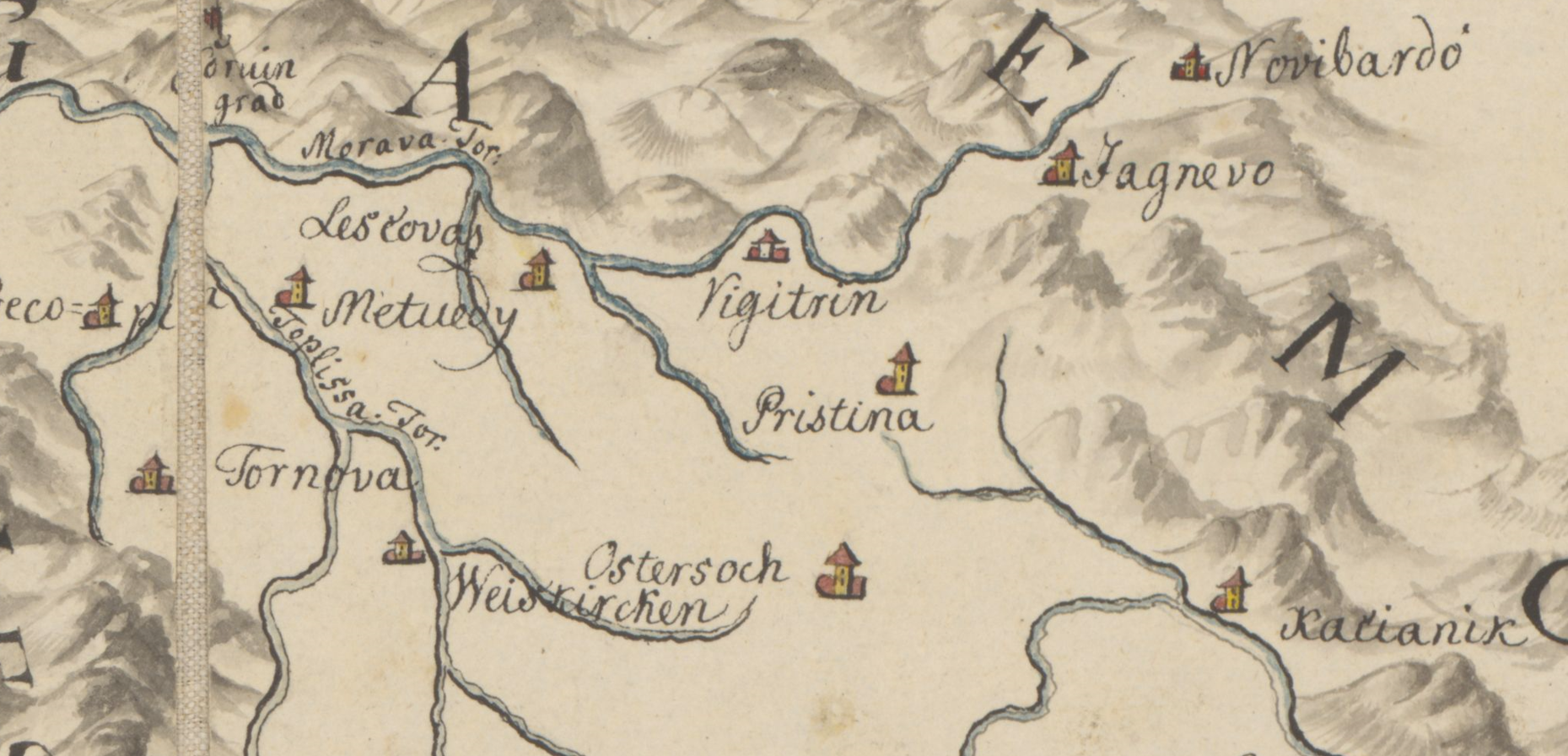
Overall, Pristina is not a very old city. This holds true if we do not consider nearly 700 years to be very long, which is approximately the time since its earliest attestations. Although a foundational document for the city has not survived, other documentary traces allow us to assume that it was established sometime in the final decades of the 13th century, alongside many similar settlements that emerged after the arrival of Saxon miners in the Balkans.¹
The oldest document mentioning the name Pristina comes from a source originating from the Banjska Monastery, near Mitrovica, dated between 1315–1318, in which “the road of Pristina, between Plemetina and Prilužje” is mentioned in passing (see: Document 1). These villages still exist today in the same location. In these early decades, the city is mentioned again several times, including in the chrysobull of Gračanica dated 1330–1321 (Document 2), and in an anonymous document from Dubrovnik, which refers to a tax owed by certain merchants from this city to be paid in Pristina (Document 3). Only in 1342 does Pristina appear with a description of its “urban” structure (Document 5). In this note from the memoirs of the Byzantine emperor John Kantakouzenos (1292–1383), the city is described as unfortified, but with a residence of a regional ruler. After this date, references to Pristina become increasingly frequent in archival records, mainly those of Ragusa (Dubrovnik), the city-republic from which a small merchant community appears to have long been active in the region.² It can be argued that Pristina was founded through the trade dynamics between the Saxons of Novo Brdo, merchants from Dubrovnik, and the local population. In particular, Saxon–Ragusan cooperation—where the former generated production and the latter created markets—stimulated the emergence of several settlements of this period, such as Novo Brdo, Brskovo, and Zvečan.³ However, Pristina was a particular type of settlement, as it was neither a mining center nor easily classifiable as either village or town.⁴ Kantakouzenos refers to Pristina in the aforementioned note as a kome (κώμη), which is neither a village nor a town, but rather an unfortified settlement (as it is usually translated). Various authors propose terms such as “station”⁵ or “market”⁶ for such settlements formed in this period. Whereas villages were characterized almost exclusively by pastoral activities, and towns by trade, crafts, and fortifications, kome had crafts and trade but no walls or fortifications.⁷ They were also closer to villages in terms of population size. The scarce surviving evidence from this period fairly convincingly shows that Pristina was such a settlement. In the first Ottoman census of Pristina in 1477, there were no more than 1,700 inhabitants.⁸ A decade later, even fewer.⁹ A settlement of 1,700 inhabitants without surrounding walls can hardly be considered a city in the modern sense of the word. When, in 1479, the Novobrdo native Martin Segoni refers to Pristina, he describes it as a “large village” (Document 14).
The population of Pristina grew from the mid-16th century, when it clearly appears as a “town” with around 3,000 inhabitants.¹⁰ More than half of these inhabitants, distributed across 20 quarters, are recorded for the first time as Muslims. A century later, in descriptions from 1660, Pristina’s population had quadrupled to around 10,000 inhabitants (Document 27). By this time, it had not only been established as an urban center, but through trade with other regions it had also become an important regional hub (Documents 25 and 32). It was precisely during these decades that the forces of the Habsburg dynasty under Leopold I from Vienna briefly included Kosovo among the territories taken from the Ottoman Empire. Pristina became the capital of Habsburg Kosovo, and according to at least one document, in the autumn of 1689 an engineer named Bafet de Comos was commissioned to produce a map of the city and draw up plans for its fortification.¹¹ It is unknown what became of these plans, or whether they were ever implemented, but this represents the earliest known reference to any urban planning of Pristina. The Habsburg imperial control lasted only a few months, and by early 1690 the Ottoman Empire had re-established control over Pristina (and Kosovo). Nevertheless, as sources show, the displaced population was reluctant to return due to poverty and increasing crime that followed.¹² Pristina was also affected by plague, as evidenced in several fragments published in this volume (Documents 22, 33, 41, 52, 62), the most recent of which, from 1836 (if we trust the testimony of the French visitor Ami Boué), claimed to have killed up to 60% of the population (Document 82).
Despite the desire to include as much information as possible about Pristina’s social life, the documentary material was too scarce to provide a comprehensive picture. Nevertheless, documents concerning knightly games from 1436 are of interest, one of which has been published here (Document 11), as well as the sale of a two-year-old slave named Luka (Document 12), and the recorded economic data of Pristina from 1569 (Document 18). Also noteworthy is a legal dispute concerning a mill in 1736 (Document 54). Religious matters are better documented. Pristina is attested to have had a Catholic church at least before 1387,¹³ and possibly also an Orthodox church before 1393 (Document 8). These churches were likely located outside the city center; otherwise, it is highly probable that one of them would later have been converted into a mosque.¹⁴ However, this does not appear to have been the case in Pristina, based on architectural evidence. Therefore, it is likely that these churches were located in the outskirts of the settlement. At that time, the town was not yet large enough to encompass the entire surrounding region under its name, so these sites could not have been far away. The Catholic church was dedicated to St. Friday (Document 29), while the Orthodox one was dedicated to the Holy Savior of Christ.¹⁵ The Ottomans had temporary control of the city during the reign of Murad I and shortly thereafter (1389), and again during the reign of Murad II in 1422, from which time at least one of Pristina’s main mosques is attested—the Čaršija mosque, which should also be the oldest urban core of the city. Evidence that this mosque was founded in 1389 comes from an inscription in the mosque that appears to be much later, dating from 1905 (Document 101). Its authenticity remains difficult to verify, though it has not been seriously challenged by scholars, with only a few exceptions.¹⁶
On the other hand, mosques and the life of Muslim religious officials are relatively well documented in archival sources. A significant portion of the material concerns appointments, replacements, and activities of the Muslim clergy. Among these, we have published several documents from the 18th century, which remains the least studied period (Documents 53, 56–57, 60–61).
As we learn from these sources, the early 18th century was characterized by efforts to rebuild social life and repopulate the city. By 1695, the population had begun to return to Pristina, although life remained difficult due to high taxes, lack of employment opportunities, and frequent attacks by bandits. As a letter states:
“Regarding our situation, we have informed the Sublime State (Ottoman), which shows mercy and creates conditions of security in our land… for two years now, drought and great price increases have prevailed in our city; we are deprived of obtaining grain and food from other regions. Our situation is also difficult due to thieves and gangs who have been attacking us again this year. Therefore, we ask that our requests be answered and that special agents be sent to establish security in our city.”¹⁷
Such conditions appear to have prompted the Sultan early on to take measures to improve the situation, ordering the establishment of a wool workshop in the city in 1699, although it is unknown whether it was ever actually built (Doc. 51). Nevertheless, a few decades later Pristina is indeed recorded as a wool-exporting center. A business enterprise called “Zagradije” also appears in archival records from the mid-18th century. One of the first documents of the new century refers to the appointment of a new lecturer in the mosque of Sultan Mehmed in the city center,¹⁸ indicating a return to normality. However, this normality should be understood as fragile, as scarce sources from this period do not allow firm conclusions about these early decades of the century. In fact, as early as August of the following year, 1702, plague was reported in Pristina (Doc. 52). A document from 1707 shows that debts of Pristina’s inhabitants were forgiven,¹⁹ indicating that petitions to the Sublime Porte for improved conditions continued.
Excerpt from the introduction to the first printed volume of “Pristina in History”, pp. 23–32.


